
This article contains affiliate links. If you purchase through these links, we may earn a commission at no extra cost to you. Full disclosure
Your body’s fat-burning machinery runs on biological clocks that respond to light, darkness, and sleep timing. Sleep in harmony with these rhythms, and your metabolism shifts into optimal fat-burning mode. Sleep at the wrong times, and you promote fat storage - regardless of diet quality.
📚 Research Sources
The National Weight Control Registry Discovery
The National Weight Control Registry, tracking over 10,000 successful weight maintainers, found that sleep duration is a critical factor. Successful maintainers average 7.5 hours - with striking consistency across demographics and weight loss methods.
Get Weekly Health Tips
Join thousands getting evidence-based wellness insights delivered free every week.
🔒 No spam. Unsubscribe anytime.
Why 7.5 specifically? It allows exactly five complete 90-minute sleep cycles, maximizing growth hormone release, fat oxidation, and metabolic efficiency while avoiding the grogginess of partial cycle completion.
People sleeping exactly 7.5 hours show more stable ghrelin and leptin patterns compared to those sleeping more or less - suggesting this duration optimizes the hunger hormones critical for weight maintenance.
Why 8 Hours May Be Too Much

Consistently sleeping over 8 hours can reduce metabolic rate and daytime energy expenditure. Successful dieters sleeping 8+ hours show increased food cravings and reduced exercise motivation compared to those maintaining 7.5 hours.
Eight hours often interrupts the sixth sleep cycle, creating grogginess and reduced morning motivation that undermines healthy lifestyle adherence. The 7.5-hour mark - five complete cycles - allows natural awakening at cycle completion.
The Energy-Motivation Connection
Successful dieters report that 7.5 hours provides optimal energy for morning exercise, meal prep, and other weight maintenance behaviors - without the sluggishness of oversleeping or fatigue of undersleeping.
Finding Your Personal Sweet Spot
While 7.5 hours is the average, individual optimization may range from 7.25-7.75 hours. Track sleep duration alongside weight, energy, and appetite patterns for 2-4 weeks. Most people find their sweet spot within 15 minutes of 7.5 hours.
Treat sleep schedule as non-negotiable - successful dieters prioritize consistency over flexibility, maintaining the same bedtime and wake time daily.
⭐ Ready to Boost Your Metabolism Naturally?
Tea Burn is a patent-pending, tasteless formula designed to be added to your tea or coffee. It may help support metabolism, energy, and natural fat burning.
*Individual results may vary. This site contains affiliate links.
How Your Body Burns Fat During Sleep
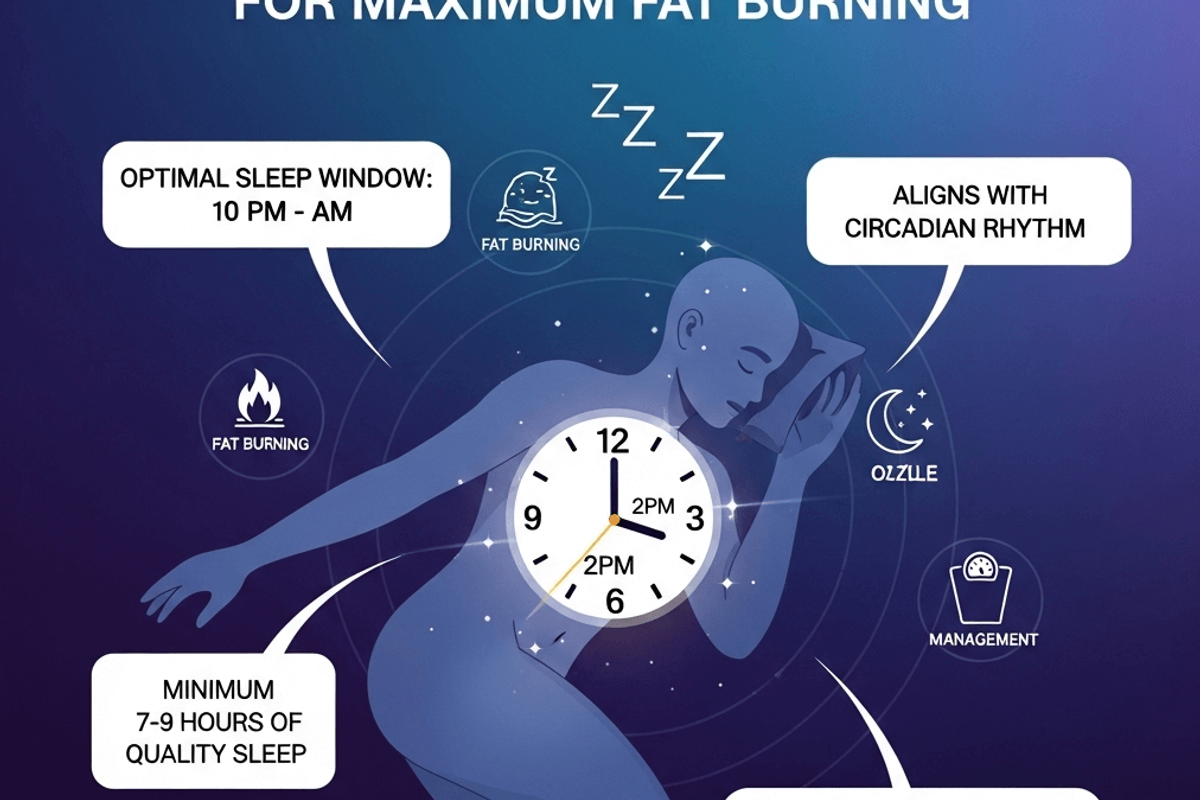
About 3-4 hours after sleep onset, glucose stores deplete and fat becomes the primary fuel source. Growth hormone - released mainly during deep sleep between 10 PM and 2 AM - acts as a powerful fat-burning signal, promoting lipolysis (breakdown of stored fat for energy). This process is significantly enhanced when sleep occurs during natural circadian windows.
The Melatonin-Metabolism Connection
Melatonin peaks between 9-10 PM and doesn’t just regulate sleep - it directly influences insulin sensitivity, cortisol regulation, and fat oxidation. Late bedtimes disrupt this production, leading to metabolic dysfunction that favors fat storage even during sleep.
The Golden Window: 10-11 PM Bedtime
Scientific evidence consistently points to 10-11 PM as optimal for fat burning. This timing aligns with natural cortisol decline, growth hormone release, and the metabolic shift from glucose to fat burning.
The Circadian Timeline
6-9 PM: Body prepares for the metabolic shift - insulin sensitivity peaks, digestion slows.
9-11 PM: Critical transition - melatonin rises, cortisol falls, growth hormone preparation begins.
10 PM-2 AM: Peak growth hormone release and maximum fat oxidation. Missing this window by sleeping late can reduce nighttime fat burning by up to 50%.
Late Bedtimes Promote Fat Storage
Sleeping after midnight keeps your body in glucose-burning mode, missing key fat oxidation windows. Late bedtimes also correlate with late eating, flooding your system with glucose when fat burning should begin.
Cortisol stays elevated instead of declining, promoting abdominal fat storage while impairing growth hormone release.
Morning Larks vs. Night Owls
Early chronotypes show superior fat oxidation patterns compared to night owls, even with identical sleep duration. Night owls can improve by gradually shifting bedtime earlier - even moving from 1 AM to 11 PM significantly improves metabolic outcomes.
Light therapy, meal timing adjustments, and strategic supplement support can help evening types shift toward metabolically beneficial sleep patterns.
The Growth Hormone Window: 10 PM - 2 AM
Growth hormone peaks between 10 PM-2 AM in people following natural sleep patterns. It directly stimulates fat breakdown while preserving muscle during caloric restriction. As we age, this production naturally declines - making optimal sleep timing even more important for maintaining metabolic health.
Meal Timing and Sleep Timing Combined effect
Eating within 3 hours of bedtime provides glucose that prevents the metabolic shift to fat burning. Early bedtimes naturally create longer fasting windows between dinner and sleep, supporting optimal nighttime fat oxidation.
Environmental Optimization
Light: Morning exposure (6-8 AM) strengthens circadian rhythms. Evening blue light after 9 PM disrupts melatonin - block it 2-3 hours before bed.
Temperature: Keep the bedroom at 65-68°F to support natural body temperature decline and enhanced fat oxidation.
🧪 What Our Research Points To
Among the natural solutions we’ve reviewed for sleep quality and metabolic health, one stands out for its dual-action approach backed by published research.
- Ingredients shown to support deep sleep and metabolic function
- Natural compounds - no habit-forming ingredients
- 60-day money-back guarantee - zero risk
No subscription required · Affiliate disclosure
Implementation Strategy
Week 1-2: Establish consistent bedtime. Optimize sleep environment and pre-sleep routine.
Week 3-4: Gradually advance bedtime with light therapy and meal timing adjustments.
Week 5-8: Fine-tune based on energy levels, sleep quality, weight trends, and hunger patterns.
Move bedtime earlier by 15-30 minutes weekly - dramatic changes often backfire. Monitor morning energy, hunger patterns, and weight trends to assess progress. Most people see improvements within 1-2 weeks.
Frequently Asked Questions
Q: Can I burn fat sleeping late if I get enough hours? - A: Total duration matters, but sleeping after midnight reduces fat oxidation by 20-40% compared to early bedtimes, even with identical duration.
Q: What if I’m a natural night owl?
A: Even night owls benefit from gradually shifting earlier. Moving from 1 AM to 11 PM significantly improves fat-burning capacity.
Q: Does eating late prevent fat burning during sleep?
A: Yes. Eating within 3 hours of bedtime prevents the metabolic shift to fat oxidation.
Q: How does age affect sleep timing for fat burning?
A: Growth hormone declines with age, making optimal sleep timing even more vital for metabolic health after 30.
Q: What temperature is best?
A: 65-68°F supports natural body temperature decline and enhanced fat oxidation during sleep.
Q: Do weekend schedule changes matter?
A: “Social jet lag” from inconsistent weekend schedules disrupts circadian rhythms and reduces fat-burning efficiency. Consistency matters.
Q: Can naps affect nighttime fat burning?
A: Long or late naps disrupt nighttime sleep. Short naps (20-30 min) before 3 PM are generally fine.
Q: Can supplements help optimize sleep timing?
A: Natural circadian support compounds can help, but behavioral changes (light exposure, meal timing) are most important.
About Us: The YWHL Editorial Team researches health, wellness, and nutrition topics by analyzing published studies and clinical data. Our goal is to help readers make informed decisions about their health. This content is for educational purposes only - always consult your healthcare provider before starting any supplement or health program.
Some of the links on this site are affiliate links, which means we may earn a commission if you click through and make a purchase, at no additional cost to you. None of the information in this blog is medical advice. It is simply for educational purposes only.
Related Reading
Related Articles
📋 Our Research-Backed Recommendation
Our research into sleep quality and metabolic health points to this supplement as a strong option, combining ingredients shown to support both areas. Protected by a 60-day guarantee.
*Affiliate link - we may earn a commission at no cost to you. Full disclosure